Daily listening Monday 4th May

Listen out for music and images from The Little Mermaid, Lion King, Toy Story and many more.

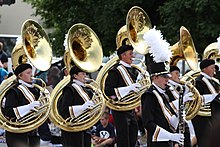
The Ohio State University Marching Band performs at Ohio State American Football games and other events during the fall semester (similar to our Autumn term). Here they are performing a Disney medley. It is one of the few all-brass and percussion bands in the USA, perhaps the largest of its type in the world. It was founded in 1878 and now has 228 members consisting of 192 pre-game marchers, 195 half-time marchers and 36 alternate members (who challenge the marchers for their spot every match).

As you can imagine, competition for places is tough and standards are very high. Once the band is picked and until the school term starts, the band practices three times a day Monday through Friday. Once term starts, the band rehearses every weekday afternoon. Many shows must be learned in as little as four days, with all music and drill (formations) committed to memory!
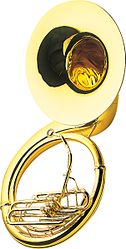
Marching bands make use of instruments specifically designed for marching. The sousaphone is a good example of this. It is a brass instrument in the same family as the tuba, and was created around 1893 at the direction of American bandleader John Philip Sousa (after whom the instrument was then named). As you can see below, it has been designed with ease of carrying and direction of sound in mind. Another brass instrument used by the band is the mellophone. This is a 2 or 3 valve instrument with a conical bore like that of the euphonium and flugelhorn. The mellophone is used as the middle-voiced brass instrument in place of French horns.
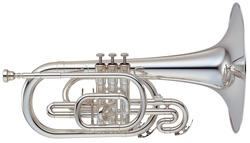
A mellophone
Sousaphones in use
A sousaphone


Watch from 5 mins 45

Watch some of this video to experience what it’s like to be performing with the Ohio State Marching Band.

Daily listening Sunday 3rd May

Philip Glass (born 1937, Maryland, USA) is considered by many to be one of the most influential contemporary (modern) classical composers of recent times. His compositions have covered many genres of music; operas, musical theatre, symphonies, concertos, string quartets, film scores and chamber music.

Philip Glass in 1993

He has been credited as one of the founders of the minimalism style of music. Minimalist music is created from short musical patterns that are repeated, layered and changed to make them interesting. Philip Glass prefers to describe it as “music with repetitive structures”.

Minimalist music often features:

  • layers of ostinati
  • constantly repeated patterns that are subjected to gradual changes
  • layered textures
  • interlocking repeated phrases and rhythms
  • diatonic harmony

Many people describe the combined effect of these features as almost hypnotic.

Diatonic means using notes which belong to the key rather than chromatic notes, which are outside the key.

Ostinati are rhythmic, melodic or harmonic patterns, which are repeated many times.

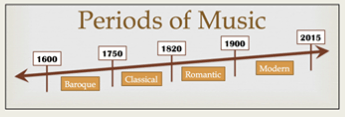
Echorus was composed in 1994 for violinists Edna Michell and Yehudi Menuhin. Its name derives from the word “echo” and the piece is based on a chaconne. A chaconne is a type of musical composition, popular during the Baroque period of music (see diagram above), usually characterised by a short, repeating bass line or harmonic progression.

According to Glass himself, Echorus was “inspired by thoughts of compassion and is meant to evoke feelings of serenity and peace”. A good choice for us to listen to in these uncertain times. Enjoy.

Daily listening Saturday 2nd May

Ralph Vaughan Williams was born in England in 1872 into a wealthy and well-connected family. His great uncle was the biologist Charles Darwin. He learnt to play piano, organ and violin, but his goal was to be a composer. He went on to compose music for over sixty years and has been described by many as “the most important English composer of his generation”.

Ralph Vaughan Williams 1872-1958
The music of Vaughan Williams is part of the modern period.

The Lark Ascending is one of his most famous and well-loved pieces. He originally composed the piece for violin and piano in 1914, revising it in 1920 for solo violin and orchestra. It was inspired by the poem of the same name by English writer, George Meredith which tells the tale of a skylark’s beautiful birdsong.

The skylark – a bird whose song is often described as the definitive sound of the countryside.
An extract from George Meredith’s poem

The piece begins with a two-bar introduction by the woodwind and string sections, after which we hear the violinist play a cadenza. A cadenza is a dramatic solo passage where the soloist plays and the orchestra pauses and remains silent. Below is an extract from the score of the beginning of the cadenza:

The cadenza was written “senza misura” meaning without bar-lines to allow the soloist to play freely.

As the piece develops, listen out for how the violin solo reflects both the bird’s song and the bird’s flight.

Every Easter, the Classic FM Hall of Fame takes place and this year The Lark Ascending was voted as the UK’s favourite piece of classical music for the tenth time in the chart’s history.

https://www.classicfm.com/radio/hall-of-fame/uk-favourite-pieces-classical-music-revealed/