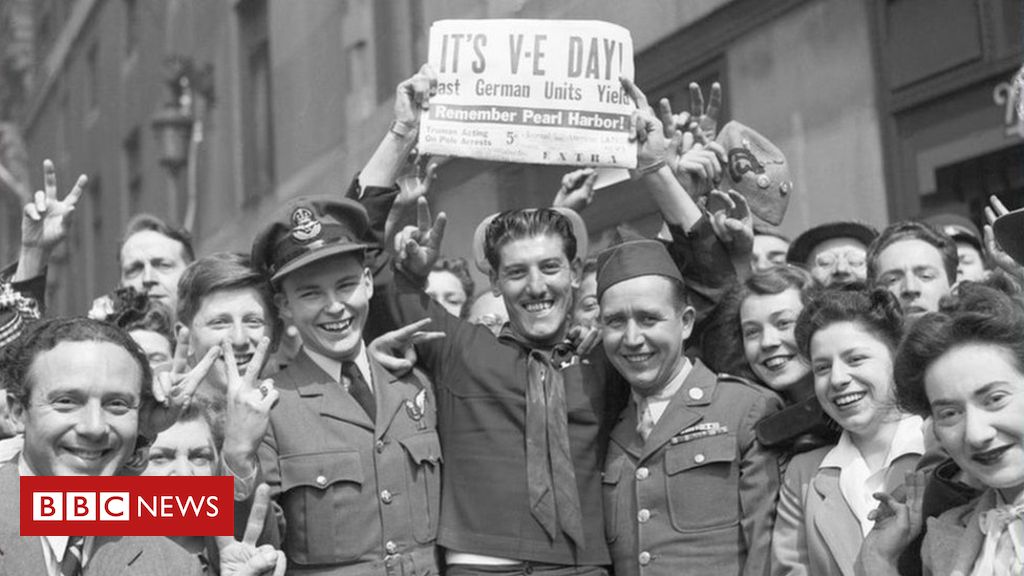
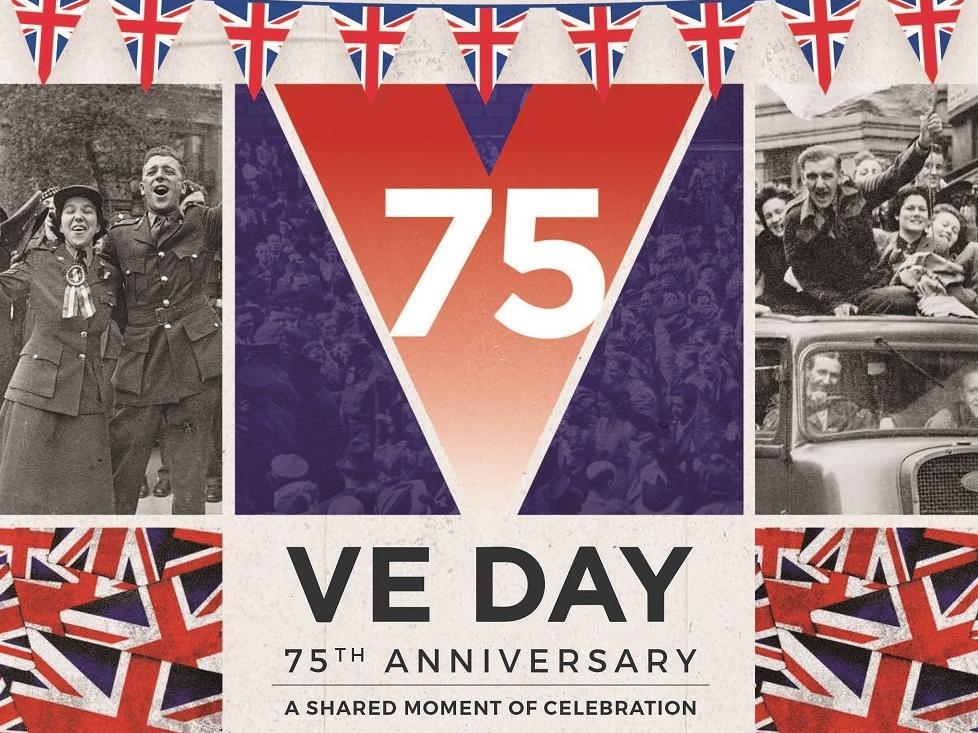
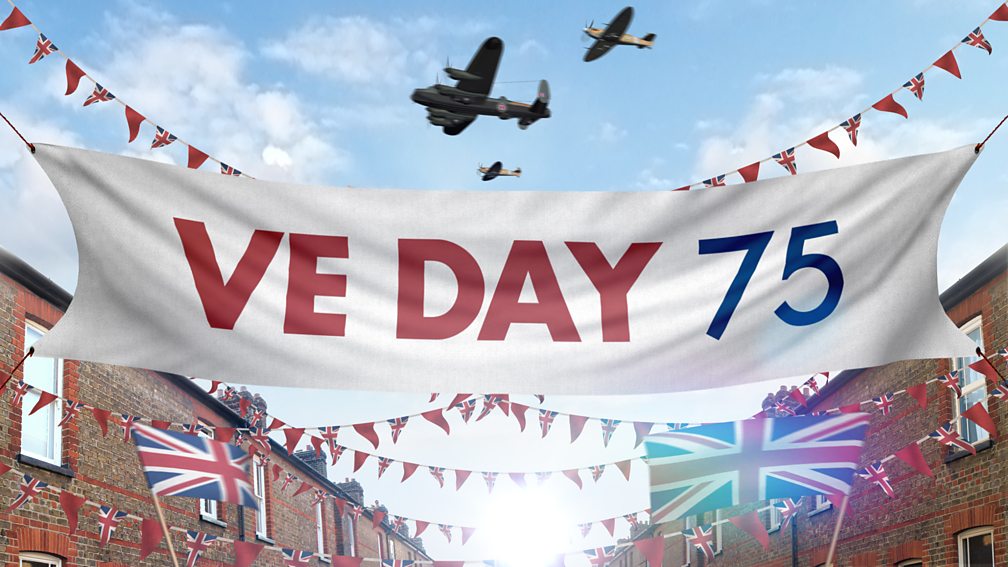
Today is the 75th anniversary of VE Day. Victory in Europe (VE) Day on 8 May 1945 saw Britain and its Allies formally accept Nazi Germany’s unconditional surrender after almost six years of war. At 15:00, Prime Minister Winston Churchill announced on the radio that the war in Europe had come to an end, following Germany’s surrender the day before.
One song that you may hear being sung during the celebrations today is We’ll Meet Again. It is a 1939 British song made famous by singer Vera Lynn with music and lyrics composed and written by English songwriters Ross Parker and Hughie Charles. The song is one of the most famous of the Second World War era, and resonated with soldiers going off to fight as well as their families and sweethearts. Dame Vera Lynn is widely known as “the Forces Sweetheart” for giving outdoor concerts for the troops in Egypt, India and Burma during the war as part of Entertainments National Service Association (ENSA). Other songs most associated with her are “The White Cliffs of Dover”, “A Nightingale Sang in Berkeley Square” and “There’ll Always Be an England”.
We’ll Meet Again by Vera Lynn
We’ll meet again Don’t know where Don’t know when But I know we’ll meet again some sunny day Keep smiling through Just like you always do ‘Till the blue skies drive the dark clouds far away
So will you please say hello To the folks that I know Tell them I won’t be long They’ll be happy to know That as you saw me go I was singing this song
We’ll meet again Don’t know where Don’t know when But I know we’ll meet again some sunny day
Here is the beautiful Aerith’s Theme from the video game series Final Fantasy. Aerith Gainsborough is a young flower seller who joins the mercenary hero Cloud Strife and his anti-government group in the pursuit of the evil Sephiroth. Her theme is played several times throughout the game, serving as a leitmotif during flashback scenes and also at her sad demise at the hands of Sephiroth. A leitmotif is a recurring musical idea (a melody, chord sequence, rhythm or a combination of these) which is associated with a particular idea, character or place. They are often used by film music composers to help build a sense of continuity (think of the famous example from the film Jaws).
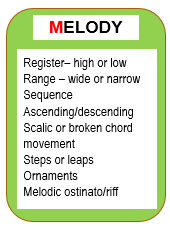
Follow the first part of the theme A from 43 seconds and notice when the melody moves in leaps or steps.
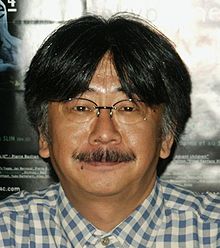
Nobuo Uematsu served as the series’ sole composer from its inception in 1986 until Final Fantasy X in 2001, when he was joined by two others.
Today, the genre of video game music has broken out of the console and computer, and become an international obsession. Major orchestras frequently hold concerts of the best-loved game music that sell out the world’s biggest concert halls, and there are now Grammy and BAFTA awards for video game music. In the UK, classical radio stations like BBC Radio 3 and Classic FM regularly broadcast video game music.
American Pie is a chart-topping song by American singer and songwriter Don McLean. He recorded and released this song on the American Pie album in 1971. The style of the music is described as “folk rock”. The song is over eight minutes long and the meaning of the mysterious lyrics have been the subject of much discussion and speculation ever since its release.
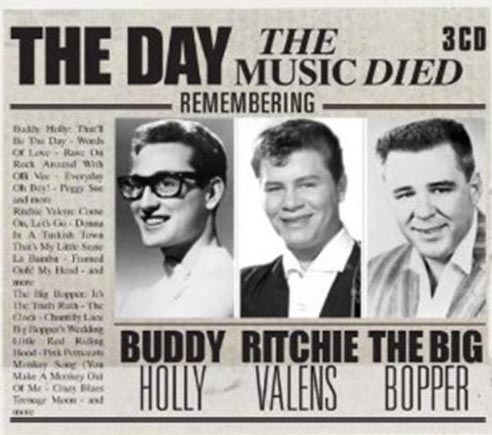
When people ask Don McLean what does American Pie really mean, he apparently likes to reply with: “It means I never have to work again!” However, most people agree that the main theme of this hit song is about the loss of innocence of the early rock and roll generation. The repeatedly mentioned phrase “the day the music died” refers to the plane crash in 1959 that killed early rock and roll performers Buddy Holly, The Big Bopper and Ritchie Valens.
Here are the full lyrics:
A long long time ago I can still remember how That music used to make me smile And I knew if I had my chance That I could make those people dance And maybe they’d be happy for a while
But February made me shiver With every paper I’d deliver Bad news on the doorstep I couldn’t take one more step
I can’t remember if I cried When I read about his widowed bride Something touched me deep inside The day the music died
So Bye, bye Miss American Pie Drove my Chevy to the levee but the levee was dry And them good ole boys were drinking whiskey and rye Singin’ this’ll be the day that I die This’ll be the day that I die
Did you write the book of love And do you have faith in God above If the Bible tells you so? Do you believe in rock and roll? Can music save your mortal soul? And can you teach me how to dance real slow?
Well, I know that you’re in love with him ‘Cause I saw you dancin’ in the gym You both kicked off your shoes Man, I dig those rhythm and blues
I was a lonely teenage broncin’ buck With a pink carnation and a pickup truck But I knew I was out of luck The day the music died I started singin’
Bye, bye Miss American Pie Drove my Chevy to the levee but the levee was dry And them good ole boys were drinking whiskey and rye Singin’ this’ll be the day that I die This’ll be the day that I die
Now, for ten years we’ve been on our own And moss grows fat on a rolling stone But, that’s not how it used to be
When the jester sang for the king and queen In a coat he borrowed from James Dean And a voice that came from you and me
Oh and while the king was looking down The jester stole his thorny crown The courtroom was adjourned No verdict was returned
And while Lennon read a book on Marx The quartet practiced in the park And we sang dirges in the dark The day the music died We were singin’
Bye, bye Miss American Pie Drove my Chevy to the levee but the levee was dry Them good ole boys were drinking whiskey and rye And singin’ this’ll be the day that I die This’ll be the day that I die
Helter skelter in a summer swelter The birds flew off with a fallout shelter Eight miles high and falling fast
It landed foul on the grass The players tried for a forward pass With the jester on the sidelines in a cast
Now the half-time air was sweet perfume While sergeants played a marching tune We all got up to dance Oh, but we never got the chance’
Cause the players tried to take the field The marching band refused to yield Do you recall what was revealed The day the music died? We started singin’
Bye, bye Miss American Pie Drove my Chevy to the levee but the levee was dry Them good ole boys were drinking whiskey and rye And singin’ this’ll be the day that I die This’ll be the day that I die
Oh, and there we were all in one place A generation lost in space With no time left to start again
So come on Jack be nimble, Jack be quick Jack Flash sat on a candlestick ‘Cause fire is the devil’s only friend
Oh and as I watched him on the stage My hands were clenched in fists of rage No angel born in Hell Could break that Satan’s spell
And as the flames climbed high into the night To light the sacrificial rite I saw Satan laughing with delight The day the music died He was singin’
Bye, bye Miss American Pie Drove my Chevy to the levee but the levee was dry Them good ole boys were drinking whiskey and rye Singin’ this’ll be the day that I die This’ll be the day that I die
I met a girl who sang the blues And I asked her for some happy news But she just smiled and turned away
I went down to the sacred store Where I’d heard the music years before But the man there said the music wouldn’t play
And in the streets the children screamed The lovers cried, and the poets dreamed But not a word was spoken The church bells all were broken
And the three men I admire most The Father, Son, and the Holy Ghost They caught the last train for the coast The day the music died And they were singing
Bye, bye Miss American Pie Drove my Chevy to the levee but the levee was dry And them good ole boys were drinking whiskey and rye Singin’ this’ll be the day that I die This’ll be the day that I die
They were singing Bye, bye Miss American Pie Drove my Chevy to the levee but the levee was dry Them good ole boys were drinking whiskey and rye Singin’ this’ll be the day that I die
Songs tend to be much shorter than eight minutes nowadays. Many attribute this to streaming services as these incentivise listening to an entire song, because that is how they calculate payments. Releasing a song that fans will listen to in full will also increase the likelihood of it being placed on a playlist.
The Star Wars fans among you may enjoy this parody of American Pie by the American musical comedian Alfred Matthew (known as “Wierd Al” Yankovic).
This is the second movement from Mozart’s Sonata for two pianos, K.448. Mozart wrote this piece in 1781 placing it in the middle of the classical period:
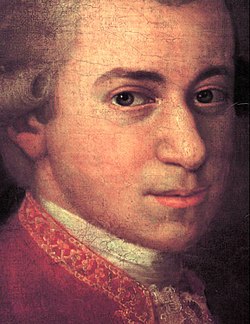
Mozart c. 1780
Wolfgang Amadeus Mozart was born in 1756 in Salzburg. He was a child prodigy. From the age of five he was competent on keyboard and violin and he was composing his own music. He went on to compose more than 600 works and he is considered among the greatest classical composers of all time.
The word ‘sonata’ comes from the Italian word for sounding. In the Classical period, ‘sonata’ came to mean a work in several movements, usually three.
This sonata is written in the key of D major. The three movements are
Allegro con spirito (Italian for lively with spirit)
Andante in G major (going at an easy pace)
Molto Allegro (very fast)
Today’s extract is the second movement which was written in ternary form. Ternary form (ABA) refers to the structure of the piece and consists of three sections; section A, a different section B, and a return to section A.
An interesting fact about this piece is that it was used by scientists to investigate whether listening to Mozart could improve the brain’s spatial reasoning skills. This became known as the “Mozart effect” but the results of the study have proven to be controversial. Read more about it here:
Listen out for music and images from The Little Mermaid, Lion King, Toy Story and many more.
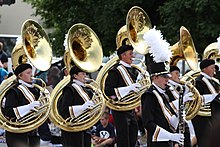
The Ohio State University Marching Band performs at Ohio State American Football games and other events during the fall semester (similar to our Autumn term). Here they are performing a Disney medley. It is one of the few all-brass and percussion bands in the USA, perhaps the largest of its type in the world. It was founded in 1878 and now has 228 members consisting of 192 pre-game marchers, 195 half-time marchers and 36 alternate members (who challenge the marchers for their spot every match).
As you can imagine, competition for places is tough and standards are very high. Once the band is picked and until the school term starts, the band practices three times a day Monday through Friday. Once term starts, the band rehearses every weekday afternoon. Many shows must be learned in as little as four days, with all music and drill (formations) committed to memory!
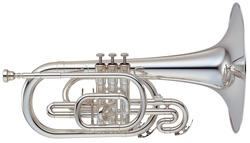
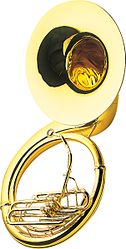
Marching bands make use of instruments specifically designed for marching. The sousaphone is a good example of this. It is a brass instrument in the same family as the tuba, and was created around 1893 at the direction of American bandleader John Philip Sousa (after whom the instrument was then named). As you can see below, it has been designed with ease of carrying and direction of sound in mind. Another brass instrument used by the band is the mellophone. This is a 2 or 3 valve instrument with a conical bore like that of theeuphonium and flugelhorn. The mellophone is used as the middle-voiced brass instrumentin place of French horns.
A mellophoneSousaphones in use
A sousaphone
Watch from 5 mins 45
Watch some of this video to experience what it’s like to be performing with the Ohio State Marching Band.
Philip Glass (born 1937, Maryland, USA) is considered by many to be one of the most influential contemporary (modern) classical composers of recent times. His compositions have covered many genres of music; operas, musical theatre, symphonies, concertos, string quartets, film scores and chamber music.
Philip Glass in 1993
He has been credited as one of the founders of the minimalism style of music. Minimalist music is created from short musical patterns that are repeated, layered and changed to make them interesting. Philip Glass prefers to describe it as “music with repetitive structures”.
Minimalist music often features:
layers of ostinati
constantly repeated patterns that are subjected to gradual changes
layered textures
interlocking repeated phrases and rhythms
diatonic harmony
Many people describe the combined effect of these features as almost hypnotic.
Diatonic means using notes which belong to the key rather than chromatic notes, which are outside the key.
Ostinati are rhythmic, melodic or harmonic patterns, which are repeated many times.
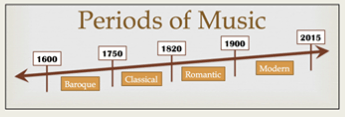
Echorus was composed in 1994 for violinists Edna Michell and Yehudi Menuhin. Its name derives from the word “echo” and the piece is based on a chaconne. A chaconne is a type of musical composition, popular during the Baroque period of music (see diagram above), usually characterised by a short, repeating bass line or harmonic progression.
According to Glass himself, Echorus was “inspired by thoughts of compassion and is meant to evoke feelings of serenity and peace”. A good choice for us to listen to in these uncertain times. Enjoy.
Ralph Vaughan Williams was born in England in 1872 into a wealthy and well-connected family. His great uncle was the biologist Charles Darwin. He learnt to play piano, organ and violin, but his goal was to be a composer. He went on to compose music for over sixty years and has been described by many as “the most important English composer of his generation”.
Ralph Vaughan Williams 1872-1958 The music of Vaughan Williams is part of the modern period.
The Lark Ascending is one of his most famous and well-loved pieces. He originally composed the piece for violin and piano in 1914, revising it in 1920 for solo violin and orchestra. It was inspired by the poem of the same name by English writer, George Meredith which tells the tale of a skylark’s beautiful birdsong.
The skylark – a bird whose song is often described as the definitive sound of the countryside.
An extract from George Meredith’s poem
The piece begins with a two-bar introduction by the woodwind and string sections, after which we hear the violinist play a cadenza. A cadenza is a dramatic solo passage where the soloist plays and the orchestra pauses and remains silent. Below is an extract from the score of the beginning of the cadenza:
The cadenza was written “senza misura” meaning without bar-lines to allow the soloist to play freely.
As the piece develops, listen out for how the violin solo reflects both the bird’s song and the bird’s flight.
Every Easter, the Classic FM Hall of Fame takes place and this year The Lark Ascending was voted as the UK’s favourite piece of classical music for the tenth time in the chart’s history.
Chichester Psalms was written in 1965 by Leonard Bernstein, who also wrote West Side Story (see our previous post on Mambo). You can hear the same infectious rhythms in this piece once the fast section starts around 0:42. It’s quite difficult to sing as the harmonies are difficult and the choir parts have a very wide range.
Leonard Bernstein (1918-1990) was a colourful character who led an extremely interesting life as a composer, conductor, pianist, author, and lecturer. Here is a great pic of him (we don’t condone smoking, but it’s great to see a ‘serious’ musician playing a kazoo!):
17-year-old Sheku Kanneh-Mason won the BBC Young Musician competition in 2016, and has gone on to have a stellar career, playing at the Proms, the Royal Variety Performance, and Prince Harry and Meghan’s wedding. Here he is playing one of the core pieces of the cello repertoire, the Prelude from J.S.Bach’s Solo Cello Suite No.1. This was composed between 1717 and 1723, making it a Baroque piece:
It is quite complicated to play! However, it is a great example of how you can make a complex pattern out of simple chords. This is the opening:
Eminem was the first hip hop artist to win an Oscar for Best Original Song, with this song in 2002. It is from the movie 8 Mile, in which Eminem plays a fictionalised version of himself, showing how he overcame various barriers before finally gaining the respect of the hip hop community.








 Hayes Music blog